Roderick on the Line by Erin Wade

ROTL is one of my favorite things. This podcast has been around for 162 episodes - over three years worth of material. It's been magnificent.

This is something that I typically recommended only to a select group of people. There are a number of hurdles to clear - you have to know about podcasts, know how to access them... And you have to be prepared to experience it.

This show is essentially 160+ of the best conversations you have ever had with this friends with whom you and they agree: there is no point to small talk.

John Roderick is a musician - former member of Harvey Danger, and lead singer and songwriter for The Long Winters. In more recent years he's been part of the ongoing geek revolution, touring with Jonathan Coulton.

But that's the tip of the iceberg. Roderick has lived a fascinating life. He's been a rock star. He's walked across Europe. He's struggled with drugs and alcohol. He's amazingly, intensely open and honest about these experiences - the good and the bad - in his music and his conversation.

Merlin Mann is the guy at the other end of the conversation. Merlin is linguistically quick - often frighteningly so - and always delighted to be at his end of the conversation. A self-described former productivity guru, Merlin does multiple podcasts each week. He appears to do this show because he loves talking with Roderick, and wants the world to have that opportunity as well.

I came by John Roderick by way of Merlin Mann. Years ago now he did a video podcast, an interview show called The Merlin Show. This was an outgrowth of his productivity website 43 Folders. It featured interviews with media and tech folk with a focus on their approach to getting things done. One episode focused on Roderick - sitting in, one presumes, Merlin's back yard. Roderick was so delightful that I wanted to know more, and I ended up buying - and loving - every Long Winters album as a result.

So why am I writing about this now?

As I mentioned, generally I'm selective about those to whom I recommend this show. Roderick is an excellent story teller, opinionated, and sometimes painfully open and honest.

And now he's running for political office. Specifically, he's running for Seattle City Council.

He's been talking about the campaign on the podcast. Let me be clear here: he has not been campaigning on the podcast. Far from it. He's been providing his usual open and honest perspective on his experience. Sometimes painfully honest.

If you've ever wondered what it is actually like to run for office - ever wanted to do more than simply consign every politician to the corrupt jackass category - the past half-dozen or so episodes of ROTL paint a very clear picture. The stresses, the struggles with advisors, with deciding whether to go negative or maintain the high road, the impact on family and personal life - it's all here, better than an Aaron Sorkin show because it's crisply, sharply real.

If anything I've said here remotely sparks your interest this show deserves your attention.

Apple Music by Erin Wade

I’ve always loved music, and over the years the overwhelming majority of my listening time has been, by necessity, done in the car. Still, over the past decade my listening has become far more heavily weighted towards audiobooks and podcasts, and away from music.

Part of the difficulty is in discovery of new material. Terrestrial radio, with its ratio of something like 12 ads per each song has truly sucked for a very long time. I’ve never gotten into satellite radio - it’s always seemed a bit of a gimmick oriented towards selling higher end features on cars - and while I’ve enjoyed Pandora quite a bit, one has to take care to “like” the right songs on a given station, or your Jethro Tull station will soon be full of hip hop (which I like, but it’s not what I’m looking for when I click on the one-legged flautist). So, often, I just ended up listening to my own collection of music. That represents a fair amount of variety, but like a lot of people my age I stopped collecting new material in earnest more than a decade ago.

But in the past week I’ve listened to more music - and more unfamiliar music than I have in month prior. The reason: the release of the new Apple Music service on June 30, 2015.

There are several new features to Apple Music, most of which are detailed in many, many other locations. Beats Radio, Apple’s live, DJ operated music feed, has gotten a great deal of attention, at least in my Twitter feed. I gave it a try, but that lasted a grand total of about three minutes for me.

The feature I am loving is the For You area. Here, based upon what you both initially indicate are your artist presences, and upon the songs you “favorite” (with a heart), you are given both album and playlist recommendations. And these, so far, have been delightful. Playlists are themed along multiple different lines - some are mix of familiar material with completely unfamiliar artists or songs blended in for discovery: Rock Hits 1977 includes much of what you would expect (Carry on my Wayward Son and Paradise by the Dashboard Light are featured), but also includes a song by UFO, a relatively obscure British heavy metal band. For a Prog Rock fan like myself it offers up playlists such as The Best of British Prog 1973–1975, which is full of bands I’ve never heard of, like the Strawbs, and Caravan, and Nektar. I don’t love them all, to be sure, but I like a lot of them and I’m hearing things that I would never have encountered before.

The other type of playlist that I’m truly enjoying are the introduction to and deep cut playlists. I’ve played the Intro to Rush playlist several times - it’s given me an opportunity to listen to a healthy cross section of music by a band I’ve always been curious about, but unwilling to take the dive to purchase any given album, being unsure whether I’d enjoy it. It’s looking like I’m pretty much gonna dig some Rush.

One of the other features of Apple Music is the fact that you can save things that you like into your own library - including these playlists.

It’s not that there aren’t clunkers in the mix - Apple has access to my music library, so it should know that I don’t really require an Intro to Jethro Tull Playlist; and a foray into a deep cuts playlist on The Police has only shown me that I don’t really love The Police (though isn’t that why we explore, what we want to know?). But overall, Apple Music has me listening to far more music - and discovering far more new music - than I have in years.

Directions by Erin Wade

image.jpg

We live in a pretty rural area, and we've been in the process of (slowly) restoring and upgrading a family home. This said, we have never been terribly traditional people.

One of the traditions of living in rural Illinois is the owning of some sort or kind of pickup truck. This isn't a tradition we've kept, as it isn't really consistent with the very mobile lifestyle we keep. But we do still need to periodically haul things.

To achieve that, our little cars (second generation Honda Fits) are pretty well equipped from the factory, but sometimes they need a little help. Up to this point we've achieved that by either using things like aftermarket roof racks or by borrowing a truck and/or trailer on the rare occasion we need to haul a larger volume of stuff. Still, part of our goal is to be self-sufficient. So I bought a trailer hitch for my car from Amazon and a trailer from Harbor Freight.

I bought them about three years ago. They haven't yet been installed or assembled. It's possible that my ideas for projects may not entirely align with my actual free time.

But this Fourth of July weekend I decided to move forward on it by starting on the process of putting together the trailer.

Now, I've interacted with a lot of products over the years for which "some assembly" was required. Still, was, perhaps, a greater adventure than I'd anticipated.

Harbor Freight appears to specialize in relatively low cost tools and other items, which is why, in part, we purchased the trailer from them (the other reason was that it folds in half, making for easier storage). Sometimes, though, you get what you pay for.

Here I am referring to the directions. First, I downloaded them online, to make them available on my iPad for quick reference which, you know, is kind of awesome. But that's where the awesome ends.

There were many, many parts for this trailer. They consist of several lengths of steel, all similar in size and composition, all painted the same color. In the directions they are referred to by name - e.g. "2B" - which would be great except the parts themselves are not marked in any way, shape, or form.

Truly, I would like to ask what the point is of giving the different parts different labels if there is, in fact, no corresponding label on the part?

Fortunately the pictures were fairly decent, and I do have a fair amount of experience with putting things together from the aforelinked Nordic furniture company, so I've been able to muddle my way through.

But honestly... Well... Ugh!

Drawing with Paper and Pencil by Erin Wade

A comment I recently made on FaceBook about the lack of value of preserving stacks and stacks of personal books caused someone to to infer that I did not like to read. This isn’t that uncommon an occurrence, frankly. I made the distinction between reading, which I truly enjoy, and feeling an allegiance to the book[1] in the form of processed dead trees bound together with glue.

I realize that most of the time, given an option, I tend to lean towards the digital solution. This is true of music, it’s true of books of all stripes - digital comics are a godsend to this former collector - and it’s true of writing (this format being a prime example).

But I realized today that I should probably come clean and admit that there is an activity that I still use old school technology to accomplish: Drawing

There are a plethora of drawing apps for the iPhone and iPad. I have a couple of them myself[2], and I’ve used each of them several times. Still, as is often the case, when I sat down today to do a new drawing project, I considered them briefly, and then went to a pencil and paper (specifically graph paper, as you can see).

This isn’t because of any particular love for the materials involved. Just as I have no particular infatuation with the bound book, I don’t love the pencil, the paper, the eraser. What I love is the process of making the picture. The difference here is that the technical skills of digital drawing are significantly different than those involved in putting graphite down on paper. I learned to draw long ago, and those skills are a little like riding a bike - they stick with you. When I am wanting to produce a drawing I end up going with those existing skills rather than choosing to climb the hill of learning something new.

What I’m gaining with this decision is the ability to start quickly and produce quickly. But I’m losing the flexibility that digital drawing offers. With what I was working on today I realized partway through - probably 45 minutes into drawing - that I was drawing in too small a space. That meant I had to start over, with a larger drawing, to accomplish what I wanted. If I’d been working in one of the apps I’d have been able to make what I was working on already larger, and wouldn’t have had to start over. It would be going to far to say that I regretted the decision at that point, but I periodically considered whether I should switch over to the iPad (which is in the picture because I was using it to reference other materials).

At some point in the not-too-distant future it is likely that iOS devices[3] are going to reach the point where it will simply work better to draw directly on them. For me, at the moment, I haven’t yet built the new skill-set needed to go that direction.


  1. Our perspective of that form being the thing we call a “book” isn’t a universal. Collections of scrolls were once referred to as books, and as we move forward into the digital age, a book once again takes on a different meaning.  ↩

  2. Sketchbook Pro and [Drawing Pad](Drawing Pad by Murtha Design Inc. https://appsto.re/us/K9Cwv.i). Sketchbook Pro is a high-end app with lots of tools and features. Drawing Pad is simpler and more oriented towards novice users. I use each of them according to what I need to accomplish with respect to the task I’m doing.  ↩

  3. Yes, I’m being very specific here. I have no confidence that Android devices will reach that capability any time soon, and I see little joy in the Microsoft camp either. I am unabashedly pro-Apple here, but this isn’t a bias. In my experience the Apple option usually just works better.  ↩

Things that Actually Kinda Suck: Just the Way You Are by Erin Wade

One of the things that one discovers when one has been trained to look at the world with an objective, skeptical eye is that there are things out there in that world that just aren't as wonderful as they might have originally seemed. Things that we believed were great that, once placed under skeptical scrutiny, actually kind of suck.

Billy Joel is a an immensely successful musician and recording artist. Among his top hits is the song Just the Way You Are

This song was a top ten hit, and got Grammy Awards for best record and best song, according to Wikipedia. I was about six years old when the song was first released and, as such, it has stood as a paragon of the romantic pop ballad for essentially my entire life. It is beloved by millions - if you ever go to a Billy Joel concert, you can hear the entire audience singing along with it. Lovers swoon when one sings it to the other, as happened on many a dance floor in my 1980's adolescence, and in many a karaoke bar.

This is because they've never examined the lyrics of the song they are singing. Just for fun, let's do that now (fair warning here - if you love this song and want to continue to do so, unexamined, stop here. I won't think any less of you. Really[^1]).


Don't go changing, to try and please me You never let me down before

We seem to start out good here - a message of unconditional acceptance and regard that would make Carl Rogers proud.

Or is it? "You never let me down before"... Is this in response to some slight?

Or is the word "before" meant to imply that it hasn't happened yet? Am I reading too much into this too soon? Let's explore a little further.

Don't imagine you're too familiar And I don't see you anymore

Why would she be imagining this? Is she imagining it? Clearly this has come up as a point of discussion, at least, if not one of argument.

I wouldn't leave you in times of trouble We never could have come this far

We've had some pretty shitty times, haven't we Baby? But we are still here even though it's been awful...

I took the good times, I'll take the bad times I'll take you just the way you are

And there's the key to the song - I'll take you just the way you are. But the line that precedes it clearly suggests that all the happiness is a thing of the past: "I took the good times" - past tense - remember those good times we had, back when?; followed by "I'll take the bad times" - future tense - cuz that's what seems to be coming along.

Which means that taking you "just the way you are" is taking you in the bad times. Which is all we are going to have going forward, apparently.

Don't go trying some new fashion Don't change the color of your hair You always have my unspoken passion Although I might not seem to care

Even though I ignore you most of the time, you should just assume that I love you deeply and passionately. The reality here is that, aside from writing this song - which he clearly hopes will stand in for all of the relationship heavy lifting that he isn't prepared to do - he would really prefer it if any and all affection or attention could just be taken as a given.

And going back to the beginning - she's clearly not imagining that he doesn't see her any more. He's admitting it here outright, though he'd clearly like her to think otherwise.

Clearly this verse is in the running for the douchiest part of the song, in neck and neck with the next:

I don't want clever conversation I never want to work that hard I just want someone that I can talk to I want you just the way you are.

Here we have the direct implication that his sweetie really isn't very smart. But, you know, that's okay, because talking to smart people is a more challenging undertaking than he wants to manage.

Implicit in that is the suggestion that he could manage it, but he'd rather not. So, you know, that's why he keeps her around.

I need to know that you will always be The same old someone that I knew What will it take till you believe in me The way that I believe in you.

Here one wants to suggest that Billy go back and read the first two-thirds of his own f*%king lyrics if he is really having trouble understanding why it is that she's having trouble believing in him. And, given his descriptions of her here, one wonders what "believing in" him in the same way as he "believes in" her would look like.

I said I love you and that's forever

No, no it wasn't. This was written for his first wife, whom he later divorced. Now, if it were not for the massive douchebaggery presented in the prior lines, I'd be tempted to give this one a pass. After all, the world of love songs is filled with declarations of "forever" and "always", so why shouldn't this song be forgiven as well?

But he's such a dick prior to this point I just can't see letting it go.

And this I promise from the heart I could not love you any better

I think the common - and perhaps intended - interpretation of this line is that he is so filled with love for her that there's simply no more that he could generate. Still, everything prior to this point is such a melange of passive-aggressive spite that it seems impossible this isn't meant that way as well. "I could not love you any better" is to say "I have exactly this much love for you, and given that you are kind of a dummy that I really just prefer to ignore most of the time, that's all you are gonna get".

It also implies that he has absolutely no intention of putting any additional effort into this relationship - what she's getting now is what she's gonna get.

I love you just the way you are.

Really?

In the end, this song is essentially a passive-aggressive finger in the eye of a person for whom it's written. One wonders if that was intentional, or if Billy Joel was unable to see the reality of the lyrics that he composed. Both possibilities are fascinating in their own right. It's also interesting that this song was written for and about the same person as the song She's Always a Woman, which is also, shall we say, a less than flattering depiction.

If we're going to dig into history, one might also note that despite the declaration that he loved her just the way she was, he later dated Elle Macpherson and then married Christie Brinkley, whom he later still left and then married a woman 32 years his junior. All of which suggests that he will love you just the way you as long as you are young and incredibly attractive.

But perhaps all of that is unfair - the art is not the artist, after all. Once it's released to the world it becomes what it is for each person who experiences it. And besides, the lyrics are still a passive-aggressive feast of awful on their own.


[^1]: Okay, I might.

I Don't Watch Sports by Erin Wade

As a rule, this is true: I don't watch sports.

This has, as you might imagine, come up many times across the course of my life. Usually in a form something like this:

Them: "Did you see what happened in the game last night?”

Me: "No"

T: "You know, where [so and so] did [something]

M: "No"

T: "But surely you..."

M: "No"

It becomes awkward - well, more awkward - after that.

There is an assumption, across a large percentage of our society, that I (and everyone else) will have been interested in, and involved in, whatever the current game is - football, baseball, basketball, hockey, etc.

I'm not.

I have had the opportunity to be exposed to sports as a spectator on multiple opportunities over the years. I have attended professional baseball games (been to Wrigley multiple times), hockey games (Blackhawks games as well as a couple of Rockford Ice Hogs games). I've sat in the stands for multiple other sporting events - high school football, youth wrestling, competitive gymnastics...

I don't revel in watching other people engage in sports.

In trying to understand this about myself - it being a somewhat atypical perspective - I've learned that there are others who have a similar perspective. Among them the eminently delightful John Hodgman:

And watching millionaires who have no loyalty to you or the city you live in hit balls with sticks for millions of dollars. What could be more comforting? Why isn’t there a ticker-tape parade for the freelance magazine writers? Where’s the ticker-tape parade for the guy whose movie review you read in the alt-weekly every week, and who lives down the block from you, and who gets drunk in the same bar as you, and, like you, will never go anywhere in his life? That guy gives you comfort as much as the millionaire who hits the ball with a stick or kicks it.

So as I say, I’m not against it, it’s just the pervasiveness and the absolute unquestioned sense of its importance that it has about itself that drives me into a kind of nerd rage, as you can tell. It emulates the kind of annoying self-confidence of the jock in general. Like, “Well, of course you love me. I am briefly the most popular person in high school because I am strong, and I was born later in the year than you, so I’m bigger than you and better at the sport than you. Of course I am a good human being. You’re the one who has to justify yourself, nerd. Yes, in four years I will be graduated from high school and the likelihood that I will become a professional athlete is close to nil, and I will go through a huge crisis of identity as I try to define who I am in a world that no longer cares about my sagging body, which is how I’ve defined myself for my whole life. But you, nerd, who’s studying something that you’re passionate about and care about, and that you’re going to do for the rest of your life, you’re the one who has to explain why the fuck you’re at this party.”

When Hodgman uttered these words - back in 2009 - there were others - notably "Suss" - who tried to make an effort to understand this perspective, observing:

The teen years seems to be the period in one's life during which individuals conclude whether or not they are sports fans. The same goes for people who realize they're gay. They stay isolated for quite some time, spout some masculine epithets at the right moments, and when they feel comfortable, suddenly they shout from the heavens: "I am … not a sports fan!"

This all seems a reasonable effort, except for the fact that it does not work as a one-size-fits-all solution.

I bike - a lot. I hike. I participate in martial arts. I am more than happy to engage, in fact, in a variety of sporting activities. What I have no interest in is watching other people do it.

There are exceptions to this rule. They primarily center around sports that I have personally engaged in. For example, I enjoy watching others engage in various martial activities - taekwondo, wrestling, boxing, or mixed martial arts. But in these events I don't identify with any abstract team - I'm just interested in watching individuals do something I enjoy exceptionally well. And I've always enjoyed rooting for people I know personally to succeed - my daughter, my teammates, my friends.

But I could not possibly care less about the actions and events of professional athletes whom I do not know, and to whom I owe absolutely no allegiance. And this, ultimately, is why I don't watch sports.

Different Medium, Different Storylines by Erin Wade

So I was getting my locks shorn yesterday, and Paula, my hairdresser, asks if I've seen Avengers: Age of Ultron yet.

Now, first, let me just say how irretrievably cool it is to have a hairdresser who is interested in stuff like The Avengers. It's a good time to be a geek.

As she snipped and we talked, the conversation got off on how the Marvel Cinematic Universe (MCU) movies vary from the original comics on which they are based. The storylines are similar, of course, but there are key differences between both the characters and the events that occur.

This isn't true just of the MCU, though. Fans of The Walking Dead who watch both the TV Show and read the comic series know that the show has strayed significantly from the books. Game of Thrones on HBO has not only varied the storyline, but they are rapidly moving into a position in the story that is past the end of the last completed book in the series. Often these changes are for reasons of economy of storytelling - the GOT books have a staggering array of characters to keep track of, for example, and the TV series is arguably better (and certainly easier to track) for the decisions made in condensing some characters together.

The comics and fantasy fan-world being what it is, I'm quite sure there are those out there who find the variations from the "original" source material well nigh offensive. There was probably a time in my life when I would have been among them.

I feel very differently about it now. In general, I find that I appreciate and prefer it when the new version varies from the old. This introduces, into what is otherwise familiar material, an important factor: surprise.

I love that I don't know, despite my reading and re-reading The Walking Dead comics series, what is going to happen to Rick and the rest of the crew over the next season, or even the next episode. What's more, I find that I enjoy thinking about the decisions the TV writers have made - parsing through why this character lived longer, that one died sooner, and the other wasn't ever introduced. In many ways it's like the television version is the story as it occurs in an alternate universe.

These variations also mean that, in these cases where I've really enjoyed the original story, really gotten into the lives and the world that was created, I now get more of that without simply having to tread over the exact same material. It's a real bonus - watching the show or movie isn't simply an exercise in finding fault with how the new version screwed up.

I'm sure there are still true-believers out there who will disagree with me, and that's fine. They can stick to their sacred texts. I'm going to enjoy my new editions.

The Wright Brothers by Erin Wade

This past week I finished listening to the biography on the Wright Brothers by David McCullough. To be honest, I entered this book with no special interest in the Wright Brothers or their story. I bought the book because it was by David McCullough[1], and because I needed to spend some credits on Audible before I lost them.

My personal mental image of the Wright Brothers has always been that of simple bicycle merchants who took up a hobby and ended up inventing a very basic and rudimentary - albeit the first - flying machine.

I had no idea.

Obviously and understandably the overwhelming majority of what the book focused on was their development of powered flight - and the story it told in this regard was excellent. I learned a great deal about how that happened, the innovations in engineering and understanding required to achieve it, and the struggles along the way. But as a bike guy, the book also left me interested in learning more about the bikes.

They were not simple bicycle merchants, they were bicycle builders. Builders in an era in which the bicycle was really coming of age - moving away from the ridiculous penny farthing designs into something very much like what we ride today.

I wanted to find pictures of their bicycles and learn more about their construction. The book mentions two models designed and built by the Wrights - the Van Cleve and the St. Clair. A very few examples of their bikes are still known to exist - one of them is at The Smithsonian National Air and Space museum, and can be seen in pictures here at Bikerumors.com, and the site Wright-Brothers.org maintains a page specifically about the bicycles, including photographs and old ads for both bicycles, and providing information on their construction.

What is striking about both models is how utterly modern these 100 year-old-plus bicycles appear. The Wright’s innovated in bike design ahead of their work in aviation. They invented a self-oiling hub - a vital item give the mostly unpaved and hence dusty streets and roads of the day. They also developed the notion of threading pedals to their posts with threads going to the right on one side (which was standard) and to the left on the other so that side wouldn’t unscrew and fall off. This was, apparently, a common problem with bikes at the time - you’d just be riding along, and the act of pedaling would cause one of your pedals to loosen, and ultimately just fall off.

What I love about this solution - threading it backwards - is that it seems so very much of a piece with what I learned from the biography about their approach to flight. It is the type of thing that, in retrospect, seems a very simple solution. But it clearly took an elegant perspective to be able to step back from what everyone was already doing, and find a different way of thinking about it in order to solve the problem.

I can heartily and happily recommend The Wright Brothers biography - it was an excellent listen from Audible, and I’m sure it would be an excellent read on your iPad or Kindle (as well as printed on pieces of the processed corpses of trees, if one wants to live that way) as well.


  1. everything I’ve read (or listened to) by David McCullough - The John Adams Biography, The Truman Biography, 1776 - has frankly been so excellent that even if it’s not about a subject I thought I was interested in (Truman was not high on my list) I will go ahead and give it a try anyway. I’ve yet to be disappointed.  ↩

Digital Life and Hard Drives by Erin Wade

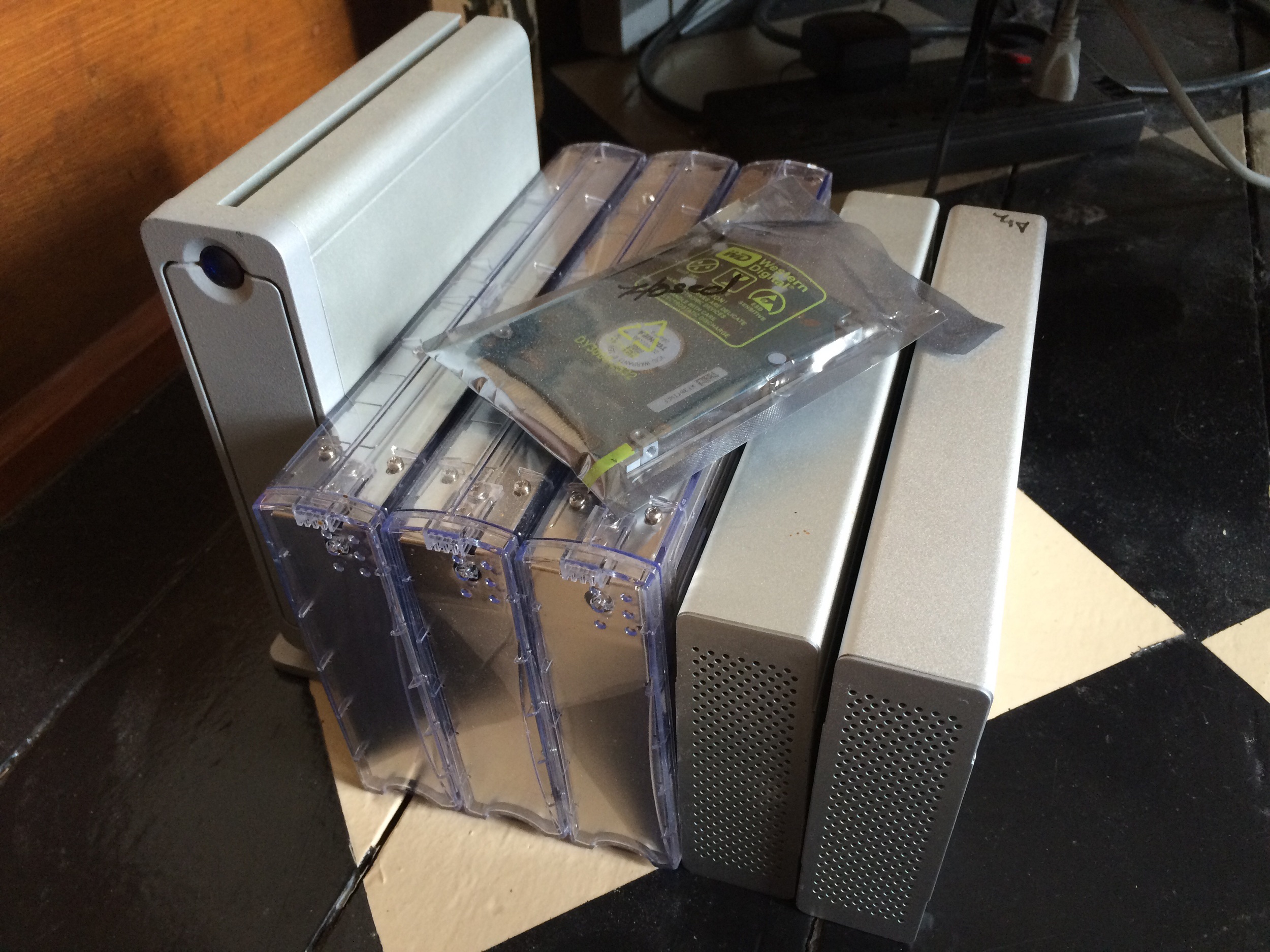
Lots of dead soldiers in house at the moment, preparing for their metaphorical trip to Arlington Cemetary... 

Lots of dead soldiers in house at the moment, preparing for their metaphorical trip to Arlington Cemetary... 

There is a saying:

There are two types of hard drives: Those that have failed, and those that will fail.

I'm not sure where I first heard that, but it is, in my experience, undeniably true.

We live a digital life - in my work we try to get as close as we can to having a paperless office, and in personal life we long ago moved towards having our entertainment options - books, movies, etc - in an electronic format. And for the most part this is wonderful. Anything you want to watch or read right at hand at any time.

It's wonderful, except when it's not.

The Achilles' Heel in the digital system is the hard drive. These devices hold tons of information, and when they are working properly it's great. But when they fail it can be a major pain in the posterior.

I write this now because I am acutely feeling that sharp, stabbing pain in my buttocks.

To be clear, the pain I am feeling is largely of my own making. When you have your media in a digital format it's incumbent upon you to have backups. And backups I do have. My system uses an old Mac Mini (my first Mac computer, in fact) running iTunes as a server for music, movies, and TV shows. This is, by modern standards, rather an old-fashioned setup. Now that there are a multitude of streaming media services in many cases all one needs is a reliable internet connection and one can forego the fiddling with drives and devices that is involved in approach. However, we have chosen to live in the middle of nowhere, which makes it far more important to have a local version of the media available. And backed up. And did I mention that I do have backups?

What I am struggling with this fine Sunday morning is what happens when the backup also fails. Hours of video is showing itself available - tantalizingly available - on a hard drive that is about to fail. But it's all a lie. Each attempt to copy one item or the next meets with an error message, the hard drive equivalent of that kid who would offer you a lick of his ice cream and then jerk it away giggling and shouting "psych".

I hate that kid.

This happens when one ignores the awful sound that the hard drive has been making for the past few days (or maybe weeks) because one knows the process of replacing it will be a tedious one. So, instead I've traded tedium for new and interesting problems.

In a way it's a bit of a blessing. I've been using this setup for nearly a decade now, and as a result am left with some legacy items that made sense at one time, but no longer really do[^1].

Fortunately I had ordered new hard drives when the primary drive had failed, so we do have a platform upon which to rebuild. I was delighted to find that Other World Computing still sells the NewerTech Mini Classic - a combination Hard Drive and USB Hub purposely designed to stack under and visually match the original Mac Mini. I've always thought these were cool items and, at this point, they are price-competitive with other external hard drives.

So now begins a process of listing and vetting all of the video that used to be readily available to determine which items are worth seeking out and downloading to have readily available. It makes one think about what makes a movie or show something you always want to have available. No Country for Old Men is undeniably an excellent film, but like Saving Private Ryan or Schindler's List it reflects a world and time that you (or, at least we) don't want to revisit regularly. We'd much rather spend our time with John McLane or Doctor Jones. And LB has already indicated that she no longer feels any need to have any iteration of the High School Musical franchise at her beck and call.

In the end this likely sounds like a lot of work, and it is. On the rare occasion that people ask I don't recommend setting up a media server in the home - it definitely requires that someone lives in the house that is willing and able to provide tech support. Still, this is the first I've needed to do this type of intervention in over five years - not a bad trade off against the enjoyment and convenience we've had in-between.

[^1]: Mostly this involves music - at one point in time the media server was the central storage hub for all of the music everyone in our little family listened to. Now, between iTunes Match and Pandora virtually everything we want to listen to is readily available somewhere, and as a result we just had old music hanging there, occupying space.

Upgrading to Worse by Erin Wade

I'm no fan of doing my taxes, but I've long found that process to be made significantly less painful using Turbo Tax. I've used the software most of the years I've done taxes probably since the late 1990's, originally on whatever desktop or laptop I had at the time; since 2011 I've been using Turbo Tax on my iPad. 

While I've always found the software to be pretty decent (something that can't always be said about Intuit's products), there was something special about doing it on the iPad. It was clear that they'd thought thru the interface and optimized it for touch - it was no half-assed desktop port. In addition, anyone who does their own taxes knows that it involves shuffling a lot of documents back and forth. This is easier, somehow, when the device you are interacting with isn't chained to a desk. Plus it made it easier to use the desktop computer for reference (for scanned receipts, spreadsheets, and the like).

So - while I don't love doing my taxes, I do enjoy interacting with well designed software, and this took the sting out of having to sit down and interact with my W-2's. I opened up the App Store on my iPad, did a search for the Turbo Tax app, and downloaded so I could get started. 

It was immediately clear that things were different. 

First, it was locked in portrait orientation. I had hoped that this was just for initially opening the program up, after which it would move to allowing landscape, but alas, no; Portrait until the cows came home (which they never did  - I don't have any cows). Data entry on the iPad's portrait keyboard is something significantly less than stellar. 

The first thing it asked for - in portrait orientation - was a login. Prior versions of this app have always asked for the password from the previous year, after which it then imports information from the prior year's app. This significantly streamlines data entry for information that doesn't often change - home address, names and identifying information for family members, etc. 

This year it asked for my username and password. This was somewhat confusing, as my records don't show a username, and when I looked at last year's app, there's not even a place to enter such a thing. So I made a couple of educated guesses - which failed - before shamefully clicking the link admitting that I'd forgotten my username and/or password. 

Except that I hadn't. 

Instead of using the information from the prior year, it took me to Intuit's website to make an account - a new account. 

The splash screen that the app shows when it opens up talks about doing your taxes on any of your devices, with generic pictures of a tablet, a laptop, etc, standing side by side in supposed harmony. This was the harbinger of the craptastic experience that followed. It quickly became clear that what Intuit had done this year was to ditch their entire prior software model and essentially make the iPad app (and, one assumes, all of the other versions of the app as well) a front end for their website. This would be fine, I suppose, if it worked well. 

It does not. 

With this new approach, one first learns that the app will not be accessing data from prior years. All of your demographic information and vital statistics have to be re-entered. In portrait orientation. This significantly extends the time that one spends doing the lovely activity of preparing one's taxes, and the suck did not end there. 

Because it is now just a front end for the website, the app apparently keeps very little information actually on the device. This means that, when one's internet connection gets hinky, or if Intuit's website is having problems, the app simply stops working. No more data entry, no more tax advice, no more nothing. For me this happened a few times through the process, most notably at the end when I was about ready to submit, at which point it told me Intuit's website was unavailable (but their engineers were aware and "hard at work" solving the problem). Heaven help you if you are doing your taxes on April 15 using this app and Comcast experiences an outage. 

And then we get to this:

No - I most certainly do not want to leave the app and go to your crappy browser, but since I need to file my taxes you've got me by the short hairs.  

No - I most certainly do not want to leave the app and go to your crappy browser, but since I need to file my taxes you've got me by the short hairs.  

Here's a hint to Intuit, and to all other app developers:  the moment your app requires me to leave the software and go to a web browser to do *anything* it has failed. This is a clear indication that you've half-assed your product.

As a bonus, I also use Mint.Com to keep track of my accounts. I actually moved to Mint to get away from the suck that Quicken had become several years ago, only to have Intuit then buy Mint. What I soon discovered was that Intuit had decided I also wanted to change my password for Mint when I created the account to do my taxes (umm - no, I did not). 

None of this would be so painful if the prior versions of the software had not been so very much better. Using this god-awful product this year was like having years of mornings where scrambled eggs and bacon are there for breakfast, and then suddenly walking in and being handed a single piece of dry white toast. 

Not that I'm bitter. 


I wrote this post. What you read next will astonish you. Or not. by Erin Wade

The Internet, and especially FaceBook, has become overrun with a plague of titles for videos and articles that are significantly more dramatic than the material to which they lead. 

The most recent version of this I've encountered:

Video:  She pours out a gallon of vinegar into her toilet. When she shows why? I ran to try it myself

(Notice - no link to this)

First:  No. No you did not watch this video, drop everything, gather up a gallon of vinegar, and immediately pour it down your toilet. I simply do not believe that happened. 

Nor did your jaw drop when you watched that other video about that thing. And yes, despite how astonishing your title tried to tell me it was, I *did* believe what happened next when I watched it. 

*If* I watched it. Which I probably did not. 

Titles like this almost invariably make me not only *not* want to watch the video or read the article, but they also make me want to delete the FaceBook app from my devices and start a petition to have Mark Zuckerburg arrested and tried for crimes against humanity (see - there's my own little bit of overblown drama there). 

Incidentally, I asked MLW to check out the video in question (it would be against my principles to follow the link myself, but it's okay, apparently, if I have someone else do it for me). I learned the following things:

- There is no "she" in the video.  The person in the video is a dude. 

- *He* doesn't use anything close to a gallon of vinegar. Maybe a cup. 

- At no point did I feel the urge to run and try it myself. 

So - you know - not only is the title irritating, it's factually inaccurate and, essentially a tease followed by a significant letdown.  

It is so frustrating when the Internet is wrong. 

Jumbl Bluetooth Audio Receiver by Erin Wade

The Jumbl with a pair of non-fancy big-box store headphones.  

The Jumbl with a pair of non-fancy big-box store headphones.  

It's no secret that I love biking, and one of the things I invariably do when I am riding my bike is listen to either audiobooks or podcasts. I made my way through huge swaths of Game of Thrones while riding my bike, and other shows like The Incomparable and Roderick on the Line have been my frequent companions as well.

I also enjoy music, but the upside to audiobooks and podcasts is that they are, generally speaking, not in stereo. I can listen to them in one ear. Since I'm often riding on public roads, with traffic, I prefer to keep at least one ear open to better detect happenings in my surroundings.

To accomplish this I have mostly been using the Jawbone bluetooth earpiece that I also have for hands-free use in the car. This setup works, but it has a couple of downsides. The first is that I have to wear the Jawbone over my left ear. The earpiece is shaped so that it sits inside the cavity of the ear, with a rubber spring that presses to hold it on the ear's surface. My right ear was cauliflowered during my senior year of high school wrestling, and there is simply no way to get it to fit. It's my left ear that faces the road when I ride, so I'd really rather have that one free.

The second is that the Jawbone is a rather expensive item and, while it does a reasonable job of staying in the ear while driving and walking, it does not appear to be up to the task when riding over rough roads on an unsuspended road bike. I've dropped it out of my ear at least once when riding down a twisting river drive in a park, and I expected never to see it again (I got lucky).

There are other options, of course. There are a variety of bluetooth headphones geared towards athletic activities. However, most of these seem to be oriented, still, towards having both ears filled. In addition, many of them are in the same price range as the Jawbone, and I struggle with the idea of dropping that kind of coin on something that it just seems I'm likely to break (I'm good at breaking things). I could also keep my phone, which is the device from which I'm listening, on my person and use standard earbuds, but I prefer to have the phone mounted on the handlebars so I can use Cyclemeter to see how fast and far I'm going.

Yes, I'm fussy and I want to have it all.

Enter Jumbl.

I've been looking for this type of device for a long time. I've had trouble explaining it to my immediate family members in any fashion that results in any kind of response other than "huh", but let me try again here:

This device is a Bluetooth receiver. It pairs with your phone (or other device) just like an earpiece or set of Bluetooth headphones. This allows you to plug your own standard, wired headphones - any standard headphones, including the $5 specials you picked up at the big-box department store - into the device to receive the audio from your phone.

These have existed for a while in larger and/or different forms - Logitech makes a version that can be used to plug into older stereo systems and radios that have either a headphone jack or an auxiliary input, for example. This is an awesome way to take your older, nice audio equipment that you invested in back in the day and ensure that it is not obsoleted by your new electronica - with these the music on your phone can be quickly and easily picked up by the stereo system you painstakingly assembled in the 1990's (or is that just me? I suspect it is not).

The Jumbl is a much smaller version of the same thing, with a battery. It clips to your clothing and lets you work hands-free but with your own cheapie headphones (or your incredibly expensive Beats, if that's what you prefer). With it being directly attached to your clothing its a lot more secure than most Bluetooth headphones and earpieces would be. Besides that, it's much less expensive than most Bluetooth headphones and earpieces, so I'll feel a lot less upset if (when) I lose it on a ride. And, since it's just using standard headphones, I can use in-ear earbuds with just one in my Jawbone-unfriendly right ear, leaving my left open to road sounds.

I actually bought the Jumbl back in January, and I've used it several times when working around the house, for example, and in the car to try it out. This past week, however, was my first opportunity to give it a good try out on the bike, riding on that same river drive upon which I'd lost the Jawbone.

It worked exceptionally well. It pairs easily, and provides good, clear sound quality. I was able to clip it to the band on my pants and run the cord up inside my shirt to keep everything secured. In essence, it functioned exactly like I wanted it to.

The device itself has controls on it - fast forward, rewind, volume, and a nice big button in the center for play/pause - and these all work well. If your headphones have audio controls on them - like the standard Apple headphones, as well as a lot of aftermarket items - they won't work with this. You'll have to use the controls on the device instead.

The Jumbl also has its own microphone, and can be used to take phone calls, operate Siri (or OkGoogle, I suppose - it is platform agnostic). The trick is that it appears to only use its own microphone, not the microphone in your headphones, so to use it this way the Jumbl has to be clipped somewhere up near your face. I've tried this out just a bit to see how it works, and it seems to be fine - a bit more by way of requests for repetition by the people on the other end of the call than with my Jawbone, but then it cost considerably less as well.

I final note here - this device is not limited to headphones - it will plug into anything using a standard 1/8” audio jack. This means that, using a patch cord it can do the same thing as the Logitech Bluetooth receiver above, or even plug into the auxiliary jack in your car stereo. With the latter approach it can take the standard stereo in any car with an aux port and give it Bluetooth capability (for audio - music, audiobooks and podcasts, GPS Directions - at least).

So - for the moment, it seems pretty cool. Now I'll just need to see how well it holds up to regular use. And, of course, how long it takes me to either break it or lose it.


An additional note here - since I purchased this device it appears that a new version has come out with two notable improvements: Bluetooth 4.0 (mine is 2.1) which allows for multiple device connections at once; and a micro usb charger. The charger the older version comes with is a proprietary design that looks like something that came with an old Nokia phone. With the new charging port, which is a standard design, you can pick up a replacement charging cable pretty much anywhere. If you are anything like me, you already have a couple of extras in your drawer-O'-technology.

It appears Amazon may be getting more of my money (though I'm pretty sure they have most of it already)...


An additional, additional note here: The items I write about here are things I have purchased myself, not promotional items I've received from the companies. This is not because of my high journalistic standards, mind you - it's just that no one sends me anything to review.

BookBook for iPad by Erin Wade

I've had an iPad of one stripe or another since the first iteration came out in 2010. I love this device, but one thing that was clear from the outset was that it would need a case. I've owned several, of various designs, and even briefly had one of my own devising(1).

The BookBook case for the iPad Air by Twelve South is, hands down, the best case I've ever owned.

Since 2010 I've been using an iPad in place of a laptop. Given that, I need a case to be protective, certainly, but I also need it to enhance the iPad's flexibility as a writing machine, and as a reference device when I am working at my iMac. It also needs to be comfortable in the hand when I am reading. The BookBook meets all of those requirements admirably.

Designed to look like a classic old leather book or journal, with a zippered closure, the spine is flexible enough to be flipped completely around backwards, and the case is rigid to allow it to function as a stand in both portrait and landscape positions. Flipped around backwards in portrait position is also a virtually perfect arrangement for holding while reading.

The BookBook sitting upright on my desk next to my iMac. And for those who are wondering, my desk is always this clean and uncluttered. I certainly would never use a blog post as an excuse to clean it off. Never... 

The BookBook sitting upright on my desk next to my iMac. And for those who are wondering, my desk is always this clean and uncluttered. I certainly would never use a blog post as an excuse to clean it off. Never... 

But probably the best part of the set-up is the typing stand. This is nothing complex - it's a rigid leather flap that folds down from the backside of the iPad holder in the case, and tilts the iPad up at about 20 degrees. The position is ideal for typing at a desk or table and, more importantly (from my perspective) for typing in a lap.

In typing position on my desk

In typing position on my desk

Close-up of the typing position. It's a simple, elegant solution.  

Close-up of the typing position. It's a simple, elegant solution.  

Undoubtedly, the choice of case is a very personal one, and this is reflected by the vast number of cases and other solutions offered for the iPad. Podcaster and Mac OS X reviewer John Siracusa has frequently referred to the design of iOS devices as working as the "robotic core" of a device that the owner then completes with his or her choice of case. If you are using your iPad as a work machine, it would be hard to find a solution that offers as much flexibility as the BookBook.


(1): some of the cases I've owned are shown below in that list of cases are

The Scosche was probably my second-favorite case - worked well and didn't make the iPad feel huge. The Rokform case was a protective case in competition with companies like Otterbox. I preferred this case by far to the Otterbox options, but it must …

The Scosche was probably my second-favorite case - worked well and didn't make the iPad feel huge. The Rokform case was a protective case in competition with companies like Otterbox. I preferred this case by far to the Otterbox options, but it must not have sold well, as the company no longer offers it.  


Dodo was one of the very first companies to offer a case for the iPad, and you can get highly customized versions of their cases with respect to color and such. I liked this case, but it's built using traditional book-binding techniques, and wears the same as you would expect a personal journal to wear. It lasted about a year for me.  


When the original iPad came out there were no cases available for it. I put all of my craft making skills to assembling the fine blue sleeve you see above out of a bubble-wrap padded envelope and blue masking tape. It may possibly be something somewhat shy of a work of art.

The Incomparable by Erin Wade

image.jpg

I sat down recently and forced myself to sit through Star Wars: Episode III - Revenge of the Sith(1), a movie so painfully bad it makes me question important components of my childhood.

Why would I do this to myself?

The Incomparable podcast.

This show is hosted by Jason Snell, former Editorial Director of MacWorld Magazine. It has nothing in particular to do with Apple Computers, or technology, however. The podcast is essentially a labor of love.

Love, that is, for a variety of very geeky things.

Whether it's books, TV shows, movies, comic books, or video games, The Incomparable tackles it with a rotating panel of tech luminaries - Dan Moren, Erica Ensign, John Siracusa, Andy Ihnatko, and Merlin Mann among several others. While the format varies somewhat from episode to episode, it frequently involves all of the panel reading, watching, or playing a given bit of media, and then talking about it. If you like geeky stuff, it's like sitting in on a conversation with like minded friends.

The variety in panelists and topic matter is a boon for discovery of new material. I've learned about new comics, movies, books, and TV shows that I've loved by listening to the show. Sometimes the topic matter is grand in scale - in episode #153 - Monkey with a Tinfoil Sandwich the crew covers three different time travel movies in extensive detail(2). In other cases the topics are minuscule. When the trailer for the Star Wars: The Force Awakens was released The Incomparable covered it, spending an hour and 12 minutes on 80 seconds of video.

The crew has also tackled each of the Star Wars movies in great detail which, of course, is why I was watching the execrable third of the (chronologically) latter three Star Wars movies. In some ways, listening to the podcast is like being part of a very good book club - one wants to be sure to have done the requisite reading to be sure of being able to participate fully.


1 - About an hour into this movie LB said to me "would you mind if I went and watched Juno"? It failed to maintain the interest of a 13-year old science fiction fan. That pretty much says all that needs be said about this movie.

2 - I re-watched Twelve Monkeys, and watched both Looper and Primer for the first time because of The Incomparable. As I discussed a little while ago, I thoroughly enjoyed two of those three activities.

The Thing About Mick by Erin Wade

I love music.

My taste could charitably be described as eclectic. It could less charitably be described as odd. I enjoy styles ranging from classical to heavy metal, and many things in-between. I love some of the artists that Everyone Can Agree On - love me some Led Zeppelin and Pink Floyd - but other Big Artists leave me cold. I think the Beatles are, frankly, only just fine (and given far more credit than they deserve) and I could be perfectly happy never hearing another song by Prince again in my life. Meanwhile, I own everything I've ever been able to find by both Jethro Tull and Queensrÿche, and I'll defend my right to listen to The Long Winters and Neko Case till the end of time.

And then there's The Rolling Stones.

While my musical tastes are certainly varied, I lean in the direction of hard and harder rock a large portion of the time. I really enjoy music steeped in blues, and songwriting that stays away from the traditional cliche'd love song. I should be a natural for The Stones.

But - you know - blah.

Here's the thing, though: I love Stones songs when done by other artists.

For example, Charlotte Martin does an exceptional version of Wild Horses:

And I could listen to Vanessa Carlton doing Paint it Black over and over again (and have):

So what's the problem?

As part of my resurged interest in Jethro Tull I set up an Ian Anderson station on Pandora a couple of weeks ago. As it rotated through the options The Stones came up three times: Paint it Black, Sympathy for the Devil, and, well, another I can't recall. As I listened to - and then skipped through - these songs I realized what it is:

I can't stand Mick Jagger's voice.

It's not (just) that he doesn't have a great voice. While it's great when it happens, rock music is full of vocalists with questionable talent. Impersonating Bob Dylan's nasal twang has been de rigeuer for comedians for decades, and Neil Young's screech is certainly something outside the realm of pleasurable. But those artists make up in passion what they lose in technical skill. I defy anyone to listen to Rockin' in the Free World and not come away knowing Neil believes deeply everything he's singing about.

But Mick? Dude just sounds... Creepy.

I'm not referring to the leathery-faced, pruned up Mick Jagger of recent years. It has nothing to do with his physical appearance at all(1) and, y'know, the guy is over 70 years old and has certainly lived a life choosing to do things with his body that certainly aren't known to slow the aging process.

It's really just the way he sings.

When I hear Charlotte Martin sing Wild Horses I hear a woman in pain. When Mick Jagger sings it, I hear a stalker who is upset about the restraining order he's just been handed. When he sings Paint it Black I hear a serial killer trying, hoping, that this time he'll be able to resist the urge...

Let's get this out of the way: Mick Jagger doesn't need me. He has a knighthood, an incredible career, and seven children. My opinion about him probably isn't going to have much of an impact on his popularity one way or the other. And I will certainly admit that he is undeniably an integral part of the songwriting team that produced these songs that I very much enjoy other people performing.

Now if he would just refrain from actually singing them...

1 - I have to admit, though, that his status as a sex symbol - at any point in his timeline - has always been mystifying to me.

Score One for Amtrak by Erin Wade

Mass transit in rural Illinois is very much a hit or miss proposition. While we have trains and busses as an option, the routes are limited and the logic behind the schedules is often difficult to fathom. For example, Amtrak runs from Mendota to Chicago three times a day on every weekday. This would seem generous, except that the earliest train arrives at Union Station at 10:35 AM.

That arrival time might be just fine for someone taking a casual trip in to do some shopping or see a show. But it is completely inadequate to offer a train commute as an option for someone who might want to work in the city but live out in the hinterlands.

In addition, the schedules are split far enough apart that, should you miss your train, you are very much stuck. I speak from experience on this, having spent an evening following the car show several years ago first running across Union Station to catch the Metra to Lisle, and then calling my Mommy to come and pick me up.

All of that noted, Amtrak demonstrated a new level of awesome for us the weekend of Valentine's Day 2015. MLW and LB were planning to spend the weekend in the City, going first to a friend's gymnastics meet at Navy Pier, and then spending the following day shopping and restauranting (is that a word?).

The trip looked like it was going to become unpleasantly complicated the morning of the trip. They had their tickets, but. We received notification - via email and through the Amtrak app - that the train was going to be delayed by several hours; delayed by enough to make them miss the gymnastics meet.

We looked our options and determined that, if need be, I could drive them in to Aurora to the Metra station there. This is a good hour of driving, one way, for us, but it still removes the need to drive in the city, find parking, etc. We solidified the plan and made periodic checks on the train status in the App to see if anything had changed.

A good hour before we needed to leave for Aurora, Amtrak actually called to let MLW know that they had added stops to another train coming through Mendota, and that they could take that train in to the city. Not only would it arrive on time for the meet, but it actually was scheduled to show up a little earlier than the original train.

Crisis averted, the ladies were able to leave from our local train station and arrive in time.

It's a small thing perhaps, in the big picture, but when you are using mass transit to move across rural regions, any breakdown in the system has the potential to make the user very inconvenienced at best. This was a show of good faith for which Amtrak deserves credit.

Staples! by Erin Wade

How do I hate thee?  Let me count the ways... 

How do I hate thee?  Let me count the ways... 

Ah - the staple.

This humble device has roots going back to the 6th century BCE, according to Wikipedia, and that same (incredibly riveting article) puts the first use of the word in reference to binding of paper back to 1895. In short, the paper staple has been dutifully serving our paper binding needs for well over a century.

They are the bane of my existence.

One of the realities of aspiring to a paperless office is that not everyone shares your aspiration - they still give you paper. This is to be expected, and anyone who provides a service has to be prepared to accept materials in the format the customer is comfortable providing. Keeping a good scanner at the ready is a part of life for any paperless office. Choose your scanner well (I can heartily recommend the Fujitsu SnapScan series) and you'll find that even large batches of documents get processed quickly and efficiently.

After you prepare them, that is.

The staple is certainly an effective means of semi-permanently bonding papers together. For this reason, the tiny staple is also the single biggest obstacle to the efficient processing of documents in a digital office.

Why is that you ask?

(Well, let's be honest: you are really asking "does this guy really spend that much time thinking about staples?"... But I digress).

There is, of course, the removing of the staples. This is time consuming and a little frustrating, as it seems that every third staple is certain that its current position in the universe is where the great stapler in the sky intended it to remain.

But there is also the fact that the process of removing the staples also alters - bends, reshapes, and sometimes tears - the paper. This presents issues with the pages as they are often then reluctant to cooperate with the document feeder on the scanner. Sometimes this is because they want to remain wed to their comrades, sliding through two and three pages at a time. At other times the pages will grab at the top of the feeder like the Dread Pirate Roberts at the Cliffs of Insanity.

As the "free" newspapers that sometimes spawn unwanted in my driveway will attest, it seems pretty clear that we are still a decade or so away from going fully digital as a culture. While we navigate through this painful, awkward transitional phase, ladies and gentleman, I submit for your consideration:

(imagine drumroll here)

The Paper Clip

The paper clip has been with us, apparently (thanks Wikipedia), for even longer than the paper staple, and so deserves our appreciation as a stalwart and loyal companion. Paper clips rarely accidentally poke holes in your fingers. Plus, they do a bang-up job of holding papers together.

And, as a bonus, the Wikipedia page for the paper clip is infinitely more interesting than the page for that troublesome staple. Apparently there is a controversy over who the actual inventor of our modern paper clip is.

With that kind of drama and excitement, how can we not embrace it?

Moving On... by Erin Wade

Last night I finally watched Looper.

I say "finally" not because this is a movie I've been waiting to see since its release. I say it not because I've had friends waiting for me to get to it so that we can talk about it. I say it because this movie has been sitting in its little Netflix sleeve on the top shelf of my entertainment center for months.

MLW and I had started to watch it back when it first arrived. I made it about halfway through the movie before consciousness betrayed me. This is no commentary on the movie, mind you. Rather, it's a simple artifact of early waking hours and long days - I have trouble staying awake even for movies and TV shows I dearly love.

So, even though I fell asleep during it, the movie seemed interesting. I held on to it, waiting for an opportunity to finish it. And besides, I've been waiting to finish listening to the episode of The Incomparable that discusses this movie along with 12 Monkeys and Primer[^1]. Unfortunately, the nature of the movie - it's an intricate time-travel story where details happening in different time lines affect what you are seeing on-screen - meant that I couldn't just play it in the background while doing other things. It had to be watched.

I finally had that opportunity last night. I was able to start the movie early enough that I would stay awake during it, and made it all the way through. And when I finished, it occurred to me to check and see how long I'd had it.

That was, perhaps, unwise.

According to Netflix, Looper first arrived at my home on July 31st, 2014. This means that it has been sitting on my shelf for over six months. The 1-DVD-at-a-time plan that we have through Netflix costs $8 per month.

So: the pleasure of holding on to Looper for all of that time effectively cost me over $48.

I did enjoy Looper. I did not, however, derive $48 worth of enjoyment from it. I could have purchased it for far less (it's $3.99 to rent, $12.99 to buy on iTunes).

And this led me to do some thinking. Probably a decade or so ago now we dropped cable in favor of a Netflix subscription. A young child and a busy schedule just made the DVD plan a much more sensible option for us. But now, as streaming video options have emerged and become pretty good, the DVD's have become less relevant. At one time we got five DVD's at a time, but had pulled that back to just one a month in favor of streaming; and, in fact, had considered just dropping the DVD plan in its entirety, but there were a handful of TV shows and movies (like Looper) that weren't available on Netflix Streaming. So we kept it for the short term, figuring on dropping it after working through that short list.

None of this is Netflix's fault, incidentally. Their service has performed just as designed. They sent me a movie, and allowed me to keep it for as long as I wanted. I could have watched it dozens - perhaps hundreds - of times in the time between delivery and return. It's my own darn fault that I've shelled out so much coin to see a movie once (with my eyes open at least).

Regardless, it is simply the case that the DVD plan doesn't make sense for us any longer. After double-checking to make sure that the handful of remaining items on my cue were available somewhere via streaming or download, I cancelled the DVD plan[^2]. It's time to move on.

[^1]: I can heartily and happily recommend both Twelve Monkeys and Looper (both of which happen to star Bruce Willis, incidentally). Primer can easily be skipped by all but the most die-hard time-travel movie buffs. On top of being a low-budget exercise with poor production values (to the degree that the actors are often difficult to hear), Primer has the additional charm of being paced slowly, with long periods of seemingly little to no action.

[^2]: An upside here for us is that we have managed to entirely skip the Blu-Ray generation of media.

[^2]: An upside here for us is that we have managed to entirely skip the Blu-Ray generation of media.

Things that must be watched by Erin Wade

I have the good fortune of having friends from a variety of walks of life. One of the interesting parts about that reality is that we have different cultural experiences. As a fan of popular media, I frequently find myself in conversation saying "you mean you haven't seen..."

Out of that experience comes this list of things that must be watched.

Television

Movies

I Don't Want Any More Computer or Console Games by Erin Wade

I am an intermittent computer gamer.

When I was young my parents brought home Pong, and later an Atari 2600. I played for hours on each of these, and can remember losing incredible amounts of enjoyable time to Pitfall and Pac Man. My first computer was a Commodore 64, and I spent hours typing in code from the back of magazines so that I could play the games that resulted (or at least play until "error line 564" and its ilk showed up), and spent copious amounts of time on Jumpman and Castle Wolfenstein.

I moved away from these things during college, returning home to find my little brother's Nintendo occupying the TV in the family room. I could never find any love in my heart for anything with Mario in it, but Arkanoid was a fast favorite, and I recall spending a fair amount of my time on the Teenage Mutant Ninja Turtles) game as well.

But those were summer flings, forgotten after I returned to school, where my relationship with computers was decidedly more chaste and task oriented. Wordstar was the name of the game for me at college, churning out papers and notes with no eye towards frivolity. I didn't return to computer gaming until I was finished with my undergrad work.

An IBM PS2, passed down to me by my Dad, spurred a return, and MLW and I could be found navigating our way around and through the world of Kings Quest and its various sequels, carefully working out paper maps to keep track of where we were and what we needed to accomplish. That machine, which never made its way out of DOS, was followed by a series of laptops purchased for school and work purposes, but which nonetheless offered up gaming opportunities. This ranged from the pre-installed Solitaire and Chess options up through Spaceward Ho! and, more recently, massive time-suck games like Warcraft, Starcraft, Diablo, and various iterations of Civilization.

Probably my favorite in the group of recents is Starcraft II, which I awaited with great anticipation. I've played through the game's story once, and I've played single-player melee's multiple times. But my play has dropped off since, and I realized something when I considered firing it up the other day:

I don't want to sit at my desk and play a game.

Computer games all share the feature of tying you down to a machine, and typically one that is best suited to remaining fixed on a hard, supporting surface. Yes, I am well aware that laptops can be used to play computer games, but I defy anyone to truthfully state they are comfortable playing a game on a laptop, actually situated in their lap, for any length of time.

This realization comes in the wake of multiple excellent games for the iPad (and, I am sure, with many identical or comparable items for Android tablets as well). With the existence of excellent games like the Infinity Blade series, Badland, and Hot Pursuit, among others, I find it hard to even consider tying myself down to a desk or table. Why would I do that when I can comfortably play on the couch? Or, weather permitting, in a lawn chair or hammock?